


Founding partner at Castle Island Ventures Nic Carter has laid out what he sees as three plausible paths for Bitcoin as the industry moves toward post-quantum cryptography: freeze vulnerable early coins, leave them untouched and accept the consequences, or pursue a legal “salvage” process that avoids a protocol-level confiscation.
The debate matters because, in Carter’s framing, roughly 1.7 million BTC in old pay-to-pubkey outputs could become exposed if Bitcoin eventually deprecates elliptic curve signatures and a cryptographically relevant quantum computer arrives.

The Third Option In Bitcoin’s Satoshi Coin Battle
In a post on X, Carter argued that the Overton window around quantum risk has shifted quickly. What was recently treated as a fringe concern, he wrote, is now increasingly being discussed as an eventual engineering and governance problem for Bitcoin itself. “The thing about the PQ transition is, it’s impossible as a Bitcoiner to claim that this protocol is cutting edge technology if Bitcoin, a monetary system predicated entirely on cryptography, is a laggard,” he wrote, adding that betting the fate of the network on the hope that the technology does not advance would be both reckless and embarrassing.
From there, Carter sketched the upgrade path he expects. After a soft fork, Bitcoin would likely move through an intermediate phase in which users could sign with existing ECC-based schemes or with new post-quantum signatures. Eventually, he wrote, legacy signatures such as ECDSA and Schnorr would be disallowed entirely. That transition, in his telling, is the easy part. The harder question comes later: what to do with coins that never migrate.
He framed that dispute as a clash between two camps already taking shape. On one side are institutions, custodians, exchanges, and fiduciaries that would view a freeze of non-migrated coins as the only acceptable option. Carter’s argument is that these actors cannot tolerate the risk that dormant holdings, including Satoshi’s coins, might suddenly be recovered by a hostile quantum-capable party and dumped into the market or otherwise used to destabilize Bitcoin.
On the other side are hardcore Bitcoiners and ideological purists who see any such freeze as a fundamental breach of the system’s monetary and political principles. Carter described their position in stark terms: “Satoshi set 21 million as the monetary parameter, and no one alive has the authority to arbitrarily modify that to 19.x million. Bitcoin doesn’t engage in selective ‘irregular state changes’ like Ethereum did after the DAO was hacked in 2016. Even after 850k BTC were lost to Mt Gox, nothing was done at the protocol layer to recover the funds.”
Carter said he believes the freeze camp is more likely to win than many Bitcoiners assume, largely because the structure of the market has changed since the 2015-2017 blocksize wars. In his view, today’s Bitcoin is far more concentrated in corporate entities, ETF issuers, custodians and large asset managers, giving “economic nodes” much more leverage than they had a decade ago. He also noted that some influential technical figures have already taken the side of freezing vulnerable coins if a genuine threat emerges.
Still, Carter’s preferred outcome is neither a freeze nor a laissez-faire approach. His “secret third thing” is a legal salvage framework. Under that scenario, a US quantum leader such as Google, IBM or another domestic firm would build the first cryptographically relevant quantum computer and, under court authority, recover the vulnerable coins into trust-like structures rather than take ownership outright.
“It would go like this,” Carter wrote. “A US firm, whether it’s Google, or IBM, or one of the other quantum leaders… acquires a CRQC first, and contracts with the US government to lawfully recover the 1.7m p2pk coins. They do not obtain ownership of these coins, but are rather appointed by a court as a neutral receiver or court-authorized custodian, tasked with securing and returning the assets to their rightful owners where possible and otherwise holding them in trust pending judicial disposition.”
In Carter’s ordering, lawful salvage is the best result, a freeze is second-best, and a no-freeze outcome ranks far behind. “If Bitcoin really does freeze the coins, then something about Bitcoin will truly have died,” he wrote. “It would survive, but it will be forever changed.”
At press time, Bitcoin traded at $74,795.
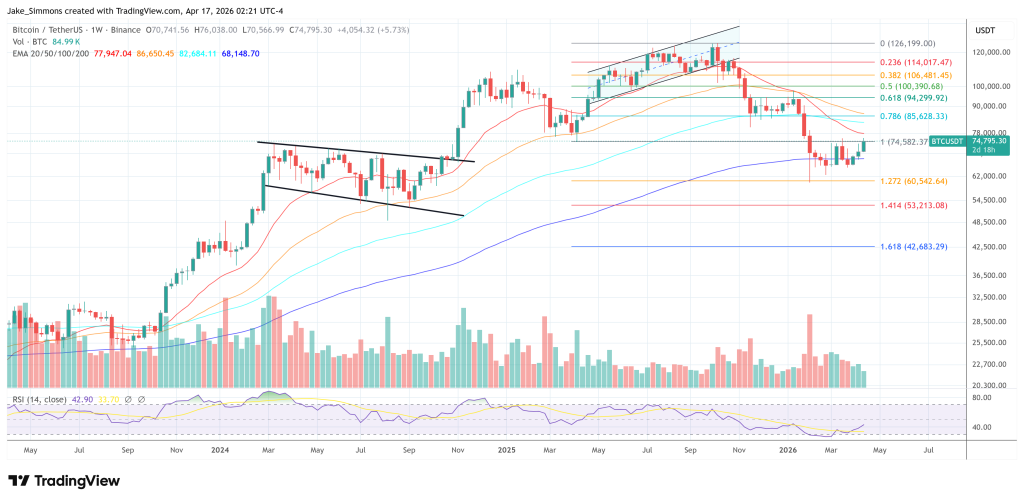
Featured image created with DALL.E, chart from TradingView.com

Editorial Process for bitcoinist is centered on delivering thoroughly researched, accurate, and unbiased content. We uphold strict sourcing standards, and each page undergoes diligent review by our team of top technology experts and seasoned editors. This process ensures the integrity, relevance, and value of our content for our readers.