



Key Points
-
Alphabet’s addition to the Dow shows how the venerable index is modernizing.
-
A merger between SpaceX and Tesla could fast-track the combined company’s inclusion.
-
But SpaceX will need to chart a path toward consistent profitability before the Dow would consider it.
- 10 stocks we like better than Space Exploration Technologies ›
On June 23, S&P Dow Jones Indices announced that Alphabet would be replacing Verizon Communications in the Dow Jones Industrial Average.
Since 2020, seven of the Dow’s 30 components have changed, including the additions of Honeywell International, Salesforce, Amgen, Amazon, Nvidia, Sherwin-Williams, and now Alphabet, and the deletions of RTX, ExxonMobil, Pfizer, Walgreens Boots Alliance, Intel, Dow, and Verizon.
Where to invest $1,000 right now? Our analyst team just revealed what they believe are the 10 best stocks to buy right now, when you join Stock Advisor. See the stocks »

Space Exploration Technologies (NASDAQ: SPCX) — otherwise known as SpaceX — has only been public for a couple of weeks. But the company has a strong case for joining the Dow one day. Here are three reasons SpaceX could eventually join the Dow, and whether the growth stock is a buy now.
Image source: Getty Images.
1. Industry leadership
With just 30 components, each Dow stock represents certain industries and a stock market sector. The strongest case for SpaceX joining the Dow is that it is the undisputed leader in the commercial space launch industry — conducting 82% of U.S. space launches.
If SpaceX can scale its Starlink network of broadband and mobile satellites, it could make a case for joining the Dow one day. And coincidentally, that segment could one day surpass the network of the very company that just got booted from the Dow — Verizon.
But Starlink is merely one aspect of SpaceX’s investment thesis. The bigger prize is artificial intelligence (AI) through SpaceX’s ownership of xAI and its goal to launch millions of AI compute satellites in space. To support that vision, SpaceX plans to build a massive chip manufacturing plant called Terafab and an integrated AI satellite facility called Gigasat in Texas. CEO Elon Musk has an impressive track record unlocking manufacturing efficiencies with Tesla (NASDAQ: TSLA) — but AI compute satellites will be far larger than Starlink satellites and carry far heavier payloads. To top it all off, SpaceX could face resistance from astronomers and nighttime sky viewers if it launches droves of AI compute satellites into Sun-synchronous orbit, causing unprecedented light pollution.
Challenges aside, SpaceX is on the cusp of becoming an industry leader in space technology for decades to come — from connectivity and AI satellites to launching payloads and maybe even interplanetary travel. If SpaceX can turn these big ideas into sustainable businesses for future growth, it stands a good chance of one day being added to the Dow.
2. Market cap
Another factor SpaceX has going for it is its size. Even after undergoing a significant sell-off, SpaceX is still one of just seven companies in the $2 trillion club alongside Nvidia, Apple, Alphabet, Microsoft, Amazon, and Taiwan Semiconductor Manufacturing. And since Taiwan Semiconductor would never be added to the Dow because it’s not a U.S. company, SpaceX is the most valuable U.S. company not in the Dow.
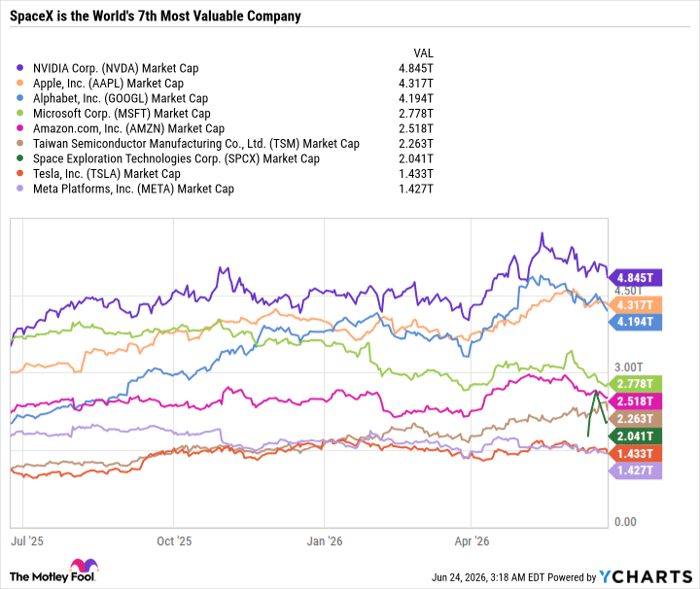
NVDA Market Cap data by YCharts
If SpaceX maintains or increases its market cap, it would strengthen the case for inclusion in the Dow. However, size alone is no guarantee of inclusion, as it took several years for Alphabet to be added even after it reached a multi-trillion valuation. And mega-cap growth stocks Meta Platforms and Tesla are not Dow components.
3. A SpaceX/Tesla merger
SpaceX’s size and industry leadership could eventually lead to its inclusion in the Dow. But the most likely path to an expedited addition would be a merger between SpaceX and Tesla.
SpaceX and Tesla’s combined market cap exceeds that of Microsoft and Amazon. SpaceX bought xAI earlier this year, but Tesla’s self-driving and robotics technologies heavily rely on xAI. What’s more, Tesla is a partner with SpaceX and xAI on Terafab. And SpaceX could benefit from Tesla’s expertise in energy storage.
It’s worth noting that there is no automative company in the Dow. General Motors was in the Dow, but was removed in 2009 in favor of Cisco Systems after GM entered bankruptcy protection. So if SpaceX and Tesla merged, it would give the Dow added exposure to automotive manufacturing, self-driving cars, robotics, energy, automation, AI, and space technologies in a similar vein as Alphabet’s addition broadened the Dow’s exposure to cloud infrastructure, AI, search, entertainment, media, self-driving cars, consumer electronics, and quantum computing.
SpaceX is well on its way to stardom
Recent Dow shakeups illustrate the index’s willingness to add non-traditional blue-chip stocks. Consistent, stodgy dividend growth is no longer a key factor. Rather, the Dow is looking for industry leaders with staying power.
While the Dow may not be the high-yield index of old, it’s unlikely to add SpaceX unless it’s consistently profitable. Salesforce was added to the index in 2020 when it didn’t pay a dividend, and Nvidia was added in 2024 when it paid a very small dividend. But both those companies had been consistently growing earnings for years. Whereas SpaceX reported a net loss in 2025 and is borrowing money to fuel its growth plans.
There’s no denying SpaceX is chock-full of potential. Years from now, SpaceX could be a household name pioneering the cutting edge of human ingenuity. But for now, investors are better off keeping SpaceX on a watchlist until it shows meaningful progress in turning grand ideas into a profitable business model.
Should you buy stock in Space Exploration Technologies right now?
Before you buy stock in Space Exploration Technologies, consider this:
The Motley Fool Stock Advisor analyst team just identified what they believe are the 10 best stocks for investors to buy now… and Space Exploration Technologies wasn’t one of them. The 10 stocks that made the cut could produce monster returns in the coming years.
Consider when Netflix made this list on December 17, 2004… if you invested $1,000 at the time of our recommendation, you’d have $398,052!* Or when Nvidia made this list on April 15, 2005… if you invested $1,000 at the time of our recommendation, you’d have $1,181,688!*
Now, it’s worth noting Stock Advisor’s total average return is 892% — a market-crushing outperformance compared to 205% for the S&P 500. Don’t miss the latest top 10 list, available with Stock Advisor, and join an investing community built by individual investors for individual investors.
See the 10 stocks »
*Stock Advisor returns as of June 27, 2026.
Daniel Foelber has positions in Nvidia. The Motley Fool has positions in and recommends Alphabet, Amazon, Amgen, Apple, Cisco Systems, Honeywell International, Intel, Meta Platforms, Microsoft, Nvidia, Pfizer, RTX, S&P Global, Salesforce, Taiwan Semiconductor Manufacturing, and Tesla. The Motley Fool recommends General Motors, Sherwin-Williams, and Verizon Communications. The Motley Fool has a disclosure policy.
The views and opinions expressed herein are the views and opinions of the author and do not necessarily reflect those of Nasdaq, Inc.